Crime, Marxism & the Vatican: How Structuralism Reshaped Justice
By Michael P. Tremoglie
How Marxist Secular Sociology Entered Strasbourg and the Vatican by Michael P. Tremoglie Why do Europe’s governing institutions and the Catholic Church — founded on different principles — now sound so similar on the subject of crime?
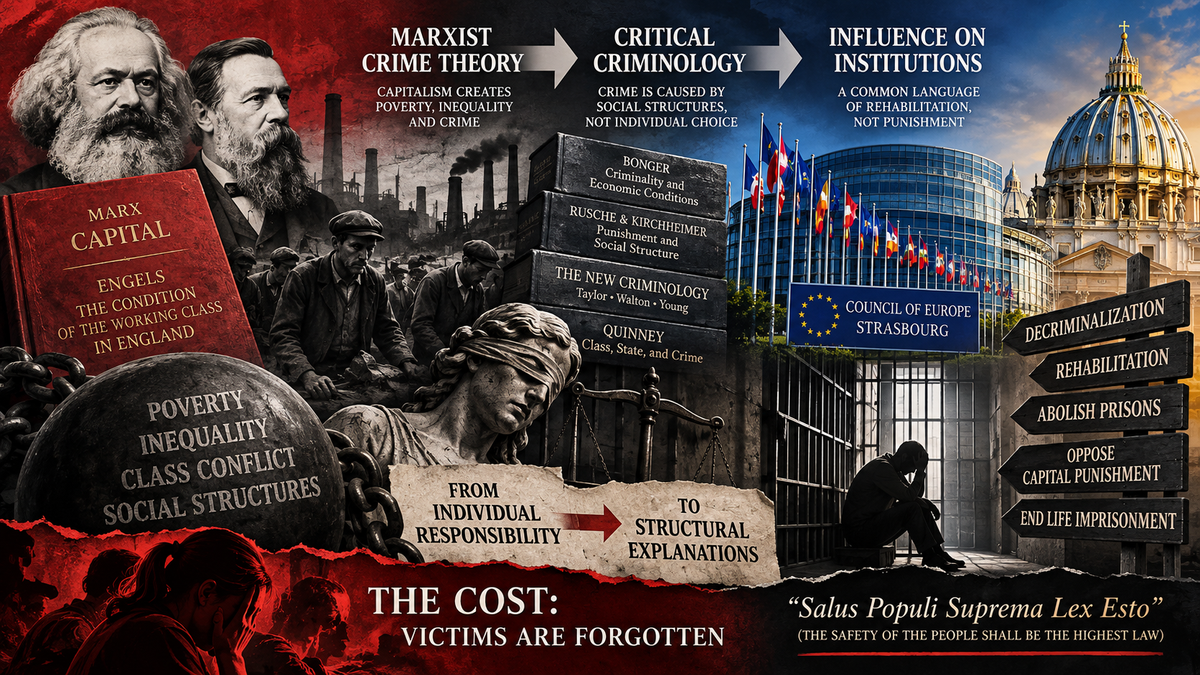
The answer lies substantially in the pernicious influence of nineteenth-century Marxist thought, filtered through twentieth-century criminology and post-conciliar Catholic theology until it shaped both institutions’ language of guilt, punishment, and reform. The lineage runs back to Engels’ The Condition of the Working Class in England (1845) and Marx’s Capital(1867), which became the foundation of Marxist crime theory. Willem Bonger’s Criminality and Economic Conditions (1905; English 1916) applied that analysis directly to crime, arguing capitalism itself bred the egoism, competition, and poverty that produced criminality — an unmistakable antecedent of “critical criminology,” decades before the term existed.
The Catholic Church had been answering Marxism since before the Communist Manifesto. Communism was both a competitor and a conscience to Catholicism — it forced the Church to confront industrial poverty and the strains capitalism placed on the working family, conditions the Church had been slow to address as workers drifted from Mass toward socialist meeting halls. Rerum Novarum (1891) condemned communism outright — rejecting class struggle and the abolition of private property — but it took the same conditions seriously, forging a socio-economic “third way” between laissez-faire capitalism and Marxism. Marxist crime theory then went under the radar for decades, taking an intellectual backseat to class conflict and the abolition of both capitalism and religion. Although the topic was still addressed in European sociology, it was preserved most notably in works like Frankfurt School scholars Georg Rusche and Otto Kirchheimer’s Punishment and Social Structure(1939), which posited that the prevailing economic order and class structure shape penal systems.
Marxist Crime Theory resurfaced with a vengeance in the 1970s. Ian Taylor, Paul Walton, and Jock Young’s The New Criminology (1973) and Richard Quinney’s Class, State, and Crime (1977) forcefully postulated that capitalism’s structural inequalities substantially produce criminal behavior. Punishment is seen as an instrument of ruling-class control of the masses. This “critical criminology” displaced the older emphasis on individual responsibility and proportional retribution with a structural diagnosis: fix the conditions, and crime recedes. Post-Vatican II theology underwent its own structural turn during this same period. Liberation theologians — Gustavo Gutiérrez, Leonardo Boff, and others — drew on Marxist class analysis to reframe sin itself as embedded in unjust structures rather than individual choice.
Rome condemned liberation theology’s explicitly Marxist elements in the Congregation for the Doctrine of the Faith’s (CDF) 1984 instruction, while its 1986 instruction affirmed an authentically Christian theology of liberation grounded in freedom from sin and personal moral responsibility. But the structural sensibility it introduced did not disappear — it persisted, re-grounded in more traditional theological language, into the Francis papacy. The language of “structures of sin,” “throwaway culture,” and an “economy that kills” appeared in Evangelii Gaudium and Laudato Si, alongside the 2018 revision of the Catechism against capital punishment and Francis’ advocacy for penal reform. These echo critical criminology’s central claim: that crime’s causes lie substantially in unjust structures, and the proper response is to transform those structures and rehabilitate the offender rather than punish him.
The Council of Europe moved in the same direction, on the same timeline. Its Committee of Experts on Decriminalization, established in 1972 and chaired by Dutch criminologist Louk Hulsman, produced the influential 1980 Report on Decriminalization. Hulsman, who was a devoted critical criminologist, wanted to go further than decriminalization and abolish prisons outright. One has to ask what the Council expected when it placed the field’s most radical abolitionist voice at the center of a decriminalization inquiry — objective assessment, or a predetermined conclusion dressed as one? The institutional channel between these two worlds was not merely theoretical.
The Holy See established relations with the Council of Europe in 1962 and received observer status in March 1970—precisely as the decriminalization initiative began —with standing to participate in the Council’s expert committees. The possibility of reciprocal influence is not speculation; the two institutions were in formal communication throughout the relevant period. By the 1970s and ‘80s, both spoke a common language: the offender’s dignity, rehabilitation over retribution, skepticism of incarceration, punishment reframed as social exclusion. Eventually, they both oppose capital punishment and life imprisonment. The prominent Polish philosopher and author Ryszard Legutko argued in The Demon in Democracy (2016) that liberal-democratic governance in Europe shares a totalizing, utopian structure with communism, not through direct lineage, but through a shared premise about creating the perfect society.
The Vatican and Strasbourg absorbed that premise through different doors, at the same historical moment, and arrived at similar conclusions. The cost of that convergence is real. When crime is explained primarily by societal structures and authority is viewed with suspicion, victims are secondary. Cicero’s warning still applies: Salus Populi Suprema Lex Esto (The safety of the people shall be the highest law). John Jay echoed this in Federalist No. 3: “Among the many objects to which a wise and free people find it necessary to direct their attention, that of providing for their SAFETY seems to be the first.” Strasbourg and Vatican City have forgotten this.
 Watch Live: Trump greets Xi Jinping at the White HouseNext PostTrump welcomes Xi to White House for landmark visit
Related Posts


Steve Gruber & The Freedom Project - One Nation (Official Music Video)
DOWNLOAD NOW->

