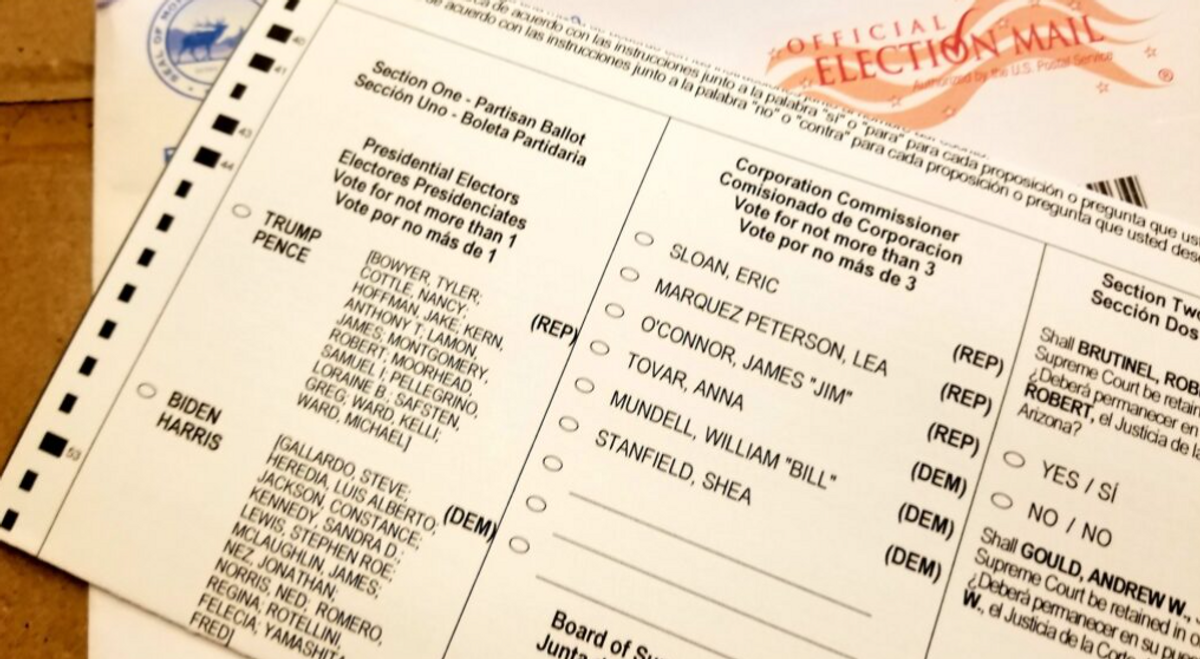
Republicans take voter registration lead from Democrats
RALEIGH, N.C. — Republicans have surpassed Democrats in voter registration in North Carolina for the first time in state history, according to data from the North Carolina State Board of Elections, marking a notable shift in one of the nation's premier battleground states ahead of the 2026 midterm elections.
As of early January 2026, the state reports approximately 2.315 million registered Republicans compared with 2.313 million registered Democrats, giving the GOP a narrow edge.
The milestone reverses a long-standing Democratic advantage. In November 2016, Democrats held a lead of more than 645,000 registered voters. Over the past decade, Republican registrations have steadily increased while Democratic numbers have declined.
RNC Chairman Joe Gruters attributed the change to the influence of President Donald Trump's "America First" agenda. "Republicans are crushing Democrats’ voter registration advantage in North Carolina and taking control statewide thanks to Michael Whatley’s leadership," Gruters said in a statement. "President Trump’s America First agenda is winning. Democrats are failing, their out-of-touch liberal agenda is being rejected, and voters are done with Roy Cooper and Josh Stein."
Michael Whatley, the former RNC chair who is now a Republican Senate candidate in North Carolina, said the shift reflects voters' desire for "a strong economy with more jobs, bigger paychecks, and lower costs."
"That’s why they’ve voted for President Donald Trump three straight times and why thousands are continuing to leave Roy Cooper’s Democrat Party," Whatley added.
NRCC Chairman Richard Hudson called the development the result of "years of good commonsense Republican governance" and a focus on issues that matter to voters. "Voters across North Carolina are rejecting the Democrats’ failed agenda and choosing Republican leadership," he said.
The North Carolina Senate race, pitting Whatley against Democratic incumbent Sen. Thom Tillis or other potential contenders, is expected to be among the most competitive and closely watched contests in the 2026 midterms.
Unaffiliated voters remain the largest group in the state, with nearly 3 million registrants. Analysts note that these voters often determine the outcome in tight statewide races, and some observers suggest the GOP's registration gains stem partly from structural changes, demographic shifts and younger voters opting out of party affiliation.
A spokesperson for the Democratic Congressional Campaign Committee downplayed the significance, noting that Republicans' share of registered voters has not grown substantially over recent decades despite efforts to redraw congressional maps. The spokesperson argued that voters are growing disillusioned with Republican policies that have contributed to higher costs for groceries, health care and living expenses.
Democrats also pointed to their 2024 successes in statewide races, including the governor's office, as evidence of continued strength in North Carolina.
Trump has carried the state in all three of his presidential campaigns, a record unmatched in the modern era. Republican strategists have expressed concern about lower turnout among Trump supporters in non-presidential years, a pattern that has historically challenged the party in midterm elections.
Whatley has said he hopes Trump will campaign extensively in North Carolina in the coming year, describing the president as "fantastically popular" in the state.
A Democratic National Committee official countered that the party is "making substantial inroads" in North Carolina and that Republicans are "scared and on defense" heading into 2026.
--REAL AMERICA'S VOICE
#####
 McCarthy demands full resignation of Minnesota's Democrat administration over fraud scandalNext PostDOJ sues to revoke citizenship of Bosnian who allegedly lied about identity when coming to US
RAV LIVE AT CPAC TEXAS DAY 1

OFFICIAL TRUTH BOMB VIDEO JUST OUT!
